
The deadlock over foreign direct investment in the retail sector continues as government officials on Tuesday informed parties opposing FDI that they will discuss their demands with the Prime Minister Manmohan Singh.

FDI equity inflows into the country during April-January 2020-21 grew by 28 per cent to $54.18 billion, according to the Commerce and Industry Ministry data released on Monday. Foreign direct investment (FDI) inflows during April-January 2019-20 stood at $42.34 billion. Total FDI (which includes reinvested earnings) during the 10-month period in FY21 increased by 15 per cent to $72.12 billion over the year-ago period.

Even so, whenever a hitherto closed sector has been opened to FDI or the sectoral investment cap has been raised, the move has drawn strong protest. The latest instance is multi-brand retail.
West Bengal Chief Minister Mamata Banerjee on Thursday criticised the Narendra Modi government over foreign direct investment in defence and railways, claiming a 49 per cent FDI cap in defence "will put a question mark" on the safety and security of the nation.
Mauritius is back in the news, and as usual not for the right reasons.

Shigeru Ishiba is expected to prioritise strengthening Japan's military capabilities and fostering deeper international partnerships, particularly with India, with whom Japan shares significant strategic interests, explains Dr Rajaram Panda.
Foreign direct investments (FDI) into the country grew 19 per cent to $59.64 billion during 2020-21 on account of measures taken by the government on the fronts of policy reforms, investment facilitation and ease of doing business, the commerce and industry ministry said on Monday. Total FDI, including equity, re-invested earnings and capital, rose 10 per cent to the "highest ever" of $81.72 billion during 2020-21 as against $74.39 billion in 2019-20. "FDI equity inflow grew by 19 per cent in 2020-21 ($59.64 billion), compared to 2019-20 ($49.98 billion)," the ministry said in a statement. In terms of top investor countries, Singapore is at the top with 29 per cent share.

The first five days of the fair from November 14-18 are restricted to business visitors.

Since the Centre tightened the Press Note 3 norms in April last, as many as 150 private equity/venture capital investment applications from China and Hong Kong are pending with the government, starving the country's start-up ecosystem of funds, says a report. The Press Note 3 (PN3) changes were effected in April, restricting foreign direct investment from countries that share land borders with India. Analysts are of the view that the move was primarily aimed at China as lot of private funds were investing billions into domestic companies.

FIPB panel to meet today, discuss telecom investments.
Company analysts and tax experts say neither the foreign direct investment nor the portfolio investment by large institutions will be affected.
Govt's decision to allow FDI will attract capital, boost confidence and soothe the nerves, say experts.

RBI feels allowing foreign companies into this business may affect financial stability.

Foreign portfolio investors (FPIs) pumped in Rs 1.7 trillion into domestic stocks in 2023, one of the highest net inflows ever witnessed during a calendar year, of which 25 per cent went into the direct buying of stocks. Data provided by depository NSDL revealed that Rs 44,950 crore of the total FPI flows last year went into primary issuances. A large portion of the FPI investments through the stock exchange route went into block deals, thereby reducing the actual investments made via direct buying of stocks. Last year saw selldowns or block deals worth Rs 2 trillion.

India, the US and 12 other members of the IPEF grouping have signed a supply chain resilience agreement that would help mitigate risks of economic disruptions from supply chain shocks and improve crisis coordination. The agreement would help member countries like India to reduce their dependence on China and provide timely information to the IPEF member countries about potential supply disruptions. The COVID outbreak severely disrupted the global supply chain, as most countries were dependent on China for various products like pharma raw materials.

Reserve Bank Governor Shaktikanta Das on Wednesday said in the wake of appreciating US dollar, the movement of rupee has remained least disruptive as compared to its peers, and the size of foreign exchange reserve is comfortable. On a financial year basis (from April to October 2022), the rupee has appreciated by 3.2 per cent in real terms, even as several major currencies have depreciated, he said while announcing the latest set of bi-monthly monetary policy. "The story of the rupee has been one of India's resilience and stability," the Governor said while pointing out that the appreciation of the US dollar this year, which precipitated large-scale depreciation of all major global currencies including the Indian rupee, has drawn wide attention.
While protests are mounting against the government policy allowing foreign direct investment in multi-brand retail, the chain, founded by Bal Gangadhar Tilak and supported by the likes of Ratanji Jamshedji Tata, is in the midst of change. Besides foreign money, it is also keen on establishing a global presence.

Reserve Bank Governor Shaktikanta Das on Friday said 67 per cent of the decline in the foreign exchange reserves since April was due to valuation changes arising from strengthening US dollar and higher American bond yields. The forex reserves, which stood at $606.475 billion as on April 2, have declined to $537.5 billion as on September 23. It was also the eighth straight week when the reserves declined.
Revision in the 2005 policy for foreign direct investment in telecom sector is likely to be announced on or before January 2, Lok Sabha was informed on Wednesday.
The government has decided to consult allies like the Trinamool Congress and the Dravida Munnetra Kazhagam before any resolution on extending the ambit of FDI to aviation by allowing foreign carriers to buy stakes in Indian ones.

The FIPB rejected two proposals -- Nigeria's Mokeme Chiwetal Izuchukwu and Lanarth Developers Pvt Ltd.

Key sectors that received maximum FDI include services, computer software and hardware, telecommunications, trading, chemicals, and automobile.

The Bilateral Aviation Safety Agreement, the civil nuclear technology transfer, telecom infrastructure security and business jet landing rights are among other "policy accomplishments in 2011" listed on the US chamber's website.

'My understanding is that by the time President Xi Jinping came for the Chennai summit [2019], he had already instructed his army to undertake the action in Galwan in the summer of 2020.'
The government on Thursday made it mandatory for all major foreign armament companies winnings contracts worth more than Rs 300 crores (Rs 3 billion) to necessarily invest thirty per cent of the amount in the country as direct offsets.

In a consultation paper issued on Tuesday, the department of industrial policy and promotion sought comments on whether FDI should be restricted to LLPs operating in sectors without any investment caps, conditionalities or entry route restrictions.

As part of it, the govt may permit 26% FDI in insurance broking through the automatic route.

According to sources, there is a proposal to allow 100 per cent Foreign Direct Investment in single brand retail sector "through automatic route" with certain conditions.
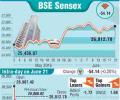
The S&P BSE Sensex shed 54 points to close at 26,813.

The avoidable stresses and strains in ties helped in one way. It showed for the entire region how a matured India handled diplomatic relations, especially with a smaller and suspicious neighbour, with practised dignity and patience, unruffled by provocations in word, deed and action, observes N Sathiya Moorthy.

Domestic institutional investors pumped Rs 2.3 trillion into equities during H1 CY24. Of this, mutual funds contributed 80%.
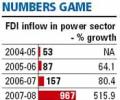
The sector attracted foreign investments to the tune of $1,252 million during the year, a 12.8 per cent decline compared to $1,437 million registered in the previous year, according to latest data released by the Department of Industrial Policy and Promotion (see table).

At present, a project with investment of more than Rs 600 crore in sectors routed through the Foreign Investment Promotion Board has to be referred to the Cabinet Committee on Economic Affairs.

The much-delayed Insurance Bill seeks to raise the foreign investment cap in the sector from 26 per cent to 49 per cent, with a rider that the management control rests in the hands of Indian promoter.

Foreign direct investment (FDI) in India's aviation sector is long overdue; the Cabinet should back Mr Singh's decision -- which was taken following a meeting with Finance Minister Pranab Mukherjee, Petroleum Minister Jaipal Reddy and Commerce Minister Anand Sharma.

The bench of Chief Justice N V Ramana and Justice Pradeep Nandrajog issued notices to the Centre, Foreign Investment Promotion Board and Commerce and Civil Aviation ministries and sought their responses by October 30.
Congress-ruled Rajasthan and Delhi had said yes; 3 states which had okayed FDI have Assembly polls next year.
The government also increased the power of the FIPB.

This FDI includes equity, re-invested earnings and other capital.

India's economy is moving towards a higher growth trajectory and is likely to grow at around 10 per cent in 2021-22, Economic Advisory Council to the Prime Minister (EAC-PM) chairman Bibek Debroy said on Wednesday. "I am confident that we are on a path towards a higher growth trajectory, higher poverty reduction, higher employment, and a prosperous, more developed and better governed India. "I think it is, more or less, agreed that the real rate of growth this year (FY2022) is going to be around 10 per cent," Debroy said at an SBI event. At the beginning of FY2021-22, the forecasts for real growth were in the 8.5-12.5 per cent range, he noted.
 © 2026 Rediff.com - Investor Information - Advertise with us - Disclaimer - Privacy Policy - Sitemap - Feedback - About us - Terms of use - Grievances